.png&w=96&q=75)
.jpg&w=96&q=75)
![[object Object]](/_next/image?url=https%3A%2F%2Fsolveit.dev%2Frails%2Factive_storage%2Fblobs%2FeyJfcmFpbHMiOnsibWVzc2FnZSI6IkJBaHBBbjRNIiwiZXhwIjpudWxsLCJwdXIiOiJibG9iX2lkIn19--9a7c715ca09c4273a63a4c964c713ab755179caa%2Fcover%2520(42).png&w=2048&q=75)
Real estate teams manage a wide range of operational workflows every day, including lead handling, listing updates, property showings, document coordination, tenant communication, payments, reporting and follow-ups. In many companies, these processes still rely on spreadsheets, emails, CRMs, property management tools, messaging apps and manual reminders, which makes coordination quite difficult as the business grows.
This is where automation in real estate becomes relevant. It helps reduce repetitive tasks, speed up communication, improve visibility across operations and make everyday processes easier to control. Thanks to it, teams spend less time on manual coordination and can dedicate more attention to client relationships, property operations and business growth.
In this article, we will delve into which real estate workflows are worth automating first, where automation delivers the biggest practical impact, and how companies can introduce it without turning operations into an overly complicated system.
What is real estate automation?
Real estate automation refers to the use of software, digital workflows, integrations, and, in some cases, AI tools to manage repetitive operational tasks across different parts of a real estate business. These can include lead handling, scheduling, tenant communication, document management, reporting, and financial operations.
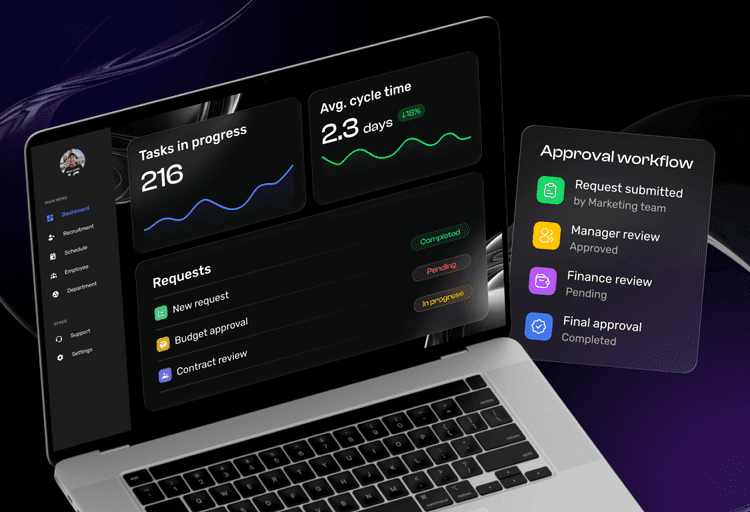
Different real estate teams can benefit from automation in different ways depending on their responsibilities. So, for instance, agents use it to better manage leads and follow-ups, property managers rely on it for maintenance requests and tenant communication while back-office teams use it to simplify reporting, approvals and document handling.
Noteworthy is that real estate process automation is not intended to reduce or eliminate the role of people or relationships in the industry. Its purpose is to minimize repetitive manual work so that teams can dedicate more time to communication, service quality, operational decisions and ongoing deals.
Why automation in real estate matters
To better understand why automation for real estate matters, it’s worth looking at the everyday operational bottlenecks that real estate teams have to deal with.

-
Time-sensitive operations – real estate work is inherently time-sensitive where timing directly influences outcomes. Even small delays in communication or execution can create friction across leasing, sales and property management workflows.
-
Slow follow-ups and lost leads – lead response speed plays a huge role in conversion, especially when clients are comparing multiple options. When follow-ups are delayed, interest drops quickly and opportunities can be lost to faster competitors.
-
Delayed documents and slower deals – transactions depend on coordinated actions between agents, clients and third parties, particularly around documents and approvals. When one step is delayed, the entire deal process tends to slow down.
-
Missed maintenance requests – in property management, maintenance requests require timely handling to maintain tenant satisfaction. In case requests are missed or processed late, it can negatively affect the overall experience and trust.
-
Manual coordination challenges – when tasks are managed manually across emails, spreadsheets, and many other tools and platforms, it becomes hard to maintain accuracy and visibility, which translates into errors, duplicated work and missed tasks.
Real estate automation, for its part, helps address these operational bottlenecks by improving response times, keeping records more organized and helping teams manage growing workloads without increasing manual coordination at the same pace.
Common real estate workflows that can be automated
Now let’s look at the areas where real estate workflow automation creates the biggest operational impact.
Lead capture and follow-up
Real estate lead automation assists with capturing incoming interest from website inquiries, listing views, and open-house leads and turns it into structured data that can be processed immediately. At the same time, real estate CRM automation helps automatically create CRM entries and route leads to the right agents without manual distribution.
The workflow can also trigger instant replies and set up follow-up reminders so that no lead is missed. Plus, with lead scoring and next-best actions, teams can focus on the most promising opportunities and respond to them more quickly.
For teams planning to create a real estate website this workflow should be considered early: inquiry forms, valuation requests, viewing bookings, and saved-property actions need to connect with the CRM and follow-up logic.
Listing and marketing workflows
Automation in real estate empowers teams to manage listing updates across multiple platforms, prepare property descriptions and coordinate email campaigns from one workflow. Marketing actions can also be triggered automatically based on events such as new listings, price changes, and status updates.
The process additionally supports appointment reminders and campaign coordination, which helps teams maintain more consistent activities without repeated manual work.
For construction-focused real estate teams, these workflows can also connect with broader construction marketing efforts, where website inquiries, campaign traffic, project updates, and CRM follow-ups need to work together to support a more predictable sales pipeline.
Showing and appointment scheduling
One of the most common real estate automation examples is automated showing and appointment scheduling that helps teams manage calendar availability, booking confirmations, reminders, and rescheduling requests within one organized workflow.
This reduces manual coordination, allows real estate teams to spend less time on back-and-forth communication, and helps decrease the number of missed appointments and no-shows.
Document and contract workflows
With real estate document automation, teams can better manage lease agreements, offers, contracts, and signatures. The process also supports document checklists, missing file reminders, and status tracking so that all the important information stays organized throughout every stage.
In addition, e-signature flows help reduce delays related to manual signing and document exchange between multiple parties.
Tenant communication and maintenance requests
Tenant communication automation makes it possible to better handle tenant requests, maintenance tickets, and status updates.
The workflow can also support SLA alerts, vendor assignment, and owner or property manager visibility, thereby helping everyone involved stay informed about ongoing tasks and unresolved issues.
Payments and financial operations
Thanks to real estate back-office automation, financial operations become more structured and easier to manage. Rent reminders, invoice matching, and reconciliation can all be handled through automated processes, which substantially reduces the need for manual tracking and repeated checks between systems.
The flow also keeps payment status updates clear and up to date, which allows teams to see what is paid, pending, or overdue without searching through multiple tools.
Plus, when required, the process connects with ERP and accounting systems in order to maintain more consistent financial data across operations.
Reporting and portfolio visibility
As you know, real estate teams need continuous visibility into occupancy rates, lead conversion, rent collection, maintenance activity, sales pipelines, and agent performance, all of which can be spread across different systems and tools.
To support this, specialized real estate dashboards consolidate data from multiple sources into a single and structured view, replacing manually compiled spreadsheet reports with real-time and up-to-date information.
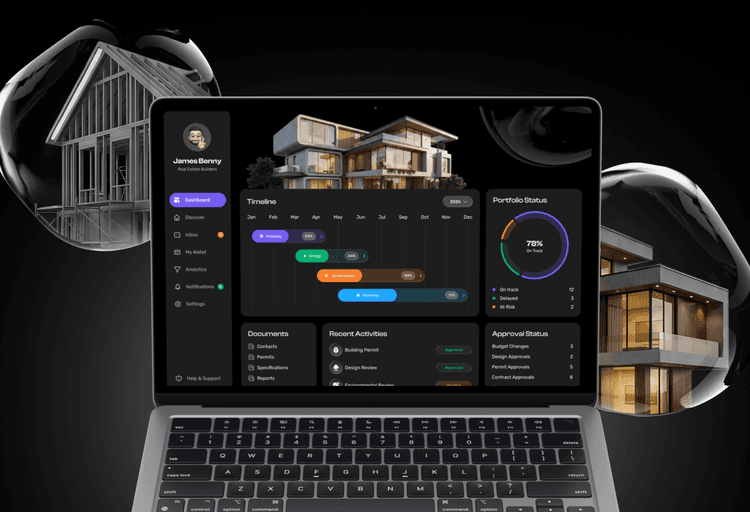
For development teams, this need for visibility often goes further than standard reporting. Real estate development project management software can help track budgets, approvals, documents, timelines, contractors, and portfolio-level progress in one more structured environment.
Find automation opportunities
in your real estate business now!
Contact usBenefits of real estate workflow automation
Real estate automation brings a number of substantial benefits such as:
-
🔄 Faster lead response – automation enables instant replies, routing, and notifications, helping teams engage potential clients while interest is still high.
-
🔄 Fewer missed follow-ups – reminders and automated sequences keep follow-ups consistent and ensure opportunities don’t slip through the pipeline.
-
🔄 Lower manual workload – routine tasks like data entry, updates, and spreadsheet management can be reduced, freeing up time for client-facing work.
-
🔄 Better document and task tracking – teams can monitor contracts, approvals, maintenance requests, and tasks in one place with clear status visibility.
-
🔄 Cleaner data across systems – integrated workflows keep CRMs, property systems, and accounting tools synchronized, reducing duplicates and manual errors.
-
🔄 Better tenant/client experience – faster responses, reminders, and consistent updates improve communication throughout the entire journey.
-
🔄 Greater visibility for managers – real-time dashboards make it easier to track performance, spot bottlenecks, and understand workload distribution.
-
🔄 Easier scaling across operations – automation helps teams keep processes consistent as they expand across more agents, properties, or locations, without requiring a proportional increase in manual coordination and administrative work.
RAG chatbot: benefits, use cases
Read articleReal estate automation examples by business type
Automation in real estate priorities generally depend on the type of business and the workflows that teams handle on a daily basis.
The thing is that different segments focus on different operational bottlenecks, which is why the use of automation tends to vary across agencies, property managers and commercial teams.
Below, we’re going to look at how automation is applied across various business types and which workflows tend to be automated first in each case.
.png&w=2048&q=75)
Real estate agencies and brokerages
Agencies and brokerages begin with automating lead routing so that incoming inquiries are distributed between agents quickly and consistently. Follow-up sequences can also be automated to make sure that every lead receives timely communication. In addition, showing reminders help reduce missed appointments by keeping both agents and clients informed about upcoming viewings.
Alongside execution workflows, many brokerages make use of agent dashboards that consolidate lead activity, conversion performance, pipeline status, and appointment data. This provides them with a more complete view of ongoing sales activity and team workload.
Property management companies
Property management companies commonly automate tenant communication and maintenance request workflows.
Property management automation is also used for rent reminders, payment updates, vendor coordination, and owner reporting as this helps managers oversee larger portfolios with fewer manual administrative tasks.
Commercial real estate teams
Commercial real estate teams apply automation in document extraction, lease abstraction, and valuation workflows. They also rely on reporting dashboards and automated due diligence workflows to improve visibility across transactions, investment portfolios, and asset performance. Teams that want these dashboards to reflect the live market often combine their automation rules with pipelines that scrape property listing data from major portals on a regular schedule.
Proptech in real estate: overview, trends, examples
Read articleWhere to start with real estate workflow automation
We often see real estate teams looking to improve efficiency but being unsure where to begin and what to keep in mind throughout the process.
Below, we will share a practical approach to real estate automation along with a few useful considerations to help you get started.
-
Avoid automating everything at once. Bear in mind that automation works best when it is introduced gradually. Thus, we advise you to focus on one workflow at a time instead of changing the entire operation in one move.
-
Map your current process. Before introducing automation, it is important for you to understand how the workflow works from start to finish. This helps uncover real bottlenecks and prevents automating unnecessary and/or inefficient steps.
-
Focus on repetitive workflows. The best starting point is workflows that occur frequently and follow a predictable structure. These processes tend to consume a lot of daily effort, so automating them tends to bring noticeable value quite quickly.
-
Prioritize high-friction processes. It is equally important to target workflows that create delays, require coordination between multiple people, or lead to information being lost between tools.
-
Define clear success metrics. To make the impact of automation easier to evaluate in practice, each workflow should have simple indicators of success such as faster response times, fewer missed tasks, reduced manual reporting, better conversion or fewer errors.
-
Validate one workflow before scaling. We strongly advise you to start with one automated workflow, observe how it performs, and refine it if needed. Once it proves reliable, automation can then be extended across other areas of your real estate business.
Not sure which real estate workflow to automate first? Let's map it together!
Contact usWhen custom workflow automation makes sense
We believe that not every real estate workflow requires custom automation since many operations can be managed effectively with standard automation solutions.
However, when processes become more specific, involve multiple connected systems and heavily depend on how a particular business is structured, standard tools may no longer fully support the way work is done and, as a result, custom automation becomes a more suitable option.
For real estate companies facing this kind of complexity, proptech software can help connect automation with the actual structure of the business, including its teams, tools, approvals, data flows, and day-to-day operational rules.
Below, we will look at the scenarios where custom workflow automation makes the most sense:
-
Business-specific workflows. Some real estate companies operate in ways that don’t fit into standard CRM or property management templates. In these cases, workflows need to reflect how the business works and custom automation, for its part, helps shape the system around that structure rather than forcing it into predefined patterns.
-
Multi-system connectivity. It’s common for many teams to use several tools at the same time, from listings and communication platforms to accounting and document systems. When information needs to move smoothly between them, custom integrations help reduce manual transfer and keep data consistent across the stack.
-
Need for custom roles, dashboards, approval logic, or portals. Larger businesses may require specific approval flows, dashboards, portals, or access levels for agents, managers, tenants, vendors, and property owners, and custom automation makes these operational structures easier to manage.
-
Legacy system limitations. Older systems sometimes lack the flexibility needed to support modern real estate operations, which forces teams to use spreadsheets, duplicated records and manual updates between tools. Custom automation helps bridge these gaps by connecting processes more effectively and reducing the need for repetitive manual workarounds.
-
Automation is part of a larger web or mobile product. Some companies prefer to build automation directly into client portals, tenant apps, internal platforms, or broader web and mobile products. In these cases, custom automation becomes part of the user experience as well as the operational infrastructure.
How SolveIt can help with real estate automation
As experts in real estate app development, workflow automation as well as business process digitalization, our team at SolveIt helps real estate companies turn their complex and fragmented operations into structured, reliable, and scalable workflows.
Below are the key services that our experts provide to support real estate automation initiatives.
-
🧭 Workflow discovery and process mapping. Through our discovery phase service, we analyze how your current real estate processes work and map out where delays, manual steps, and inefficiencies appear across teams and tools.
-
🖥️ Web portals and admin system implementation. Our web app development service experts build internal platforms that centralize listings, leads, tenants, documents, and operational tasks into one structured environment for daily use.
-
📱 Mobile tools for field operations. As part of our mobile app development сonsulting, we create mobile solutions for agents, tenants, and property managers to handle showings, requests, updates, and communication directly on the go.
-
🔗 CRM, PMS, and ERP integrations. The SolveIt team supports the integration of CRM, PMS, and ERP systems so that real estate operations run on a connected setup where client data, property management, and financial workflows stay synchronized in real time.
-
📊 Dashboards and reporting system design. We can develop and implement reporting tools that provide real-time visibility into pipelines, occupancy, maintenance, payments, and overall portfolio performance.
-
🤖 AI-supported workflow automation. Our AI in real estate experts can apply the tech where it adds practical value such as document processing, request classification, lead qualification, or report summarization.
-
🚀 MVP-first implementation approach. Within our MVP development service, we start with a focused version of the solution that validates key workflows quickly and then gradually expand based on real operational feedback.
Want to automate a real estate workflow? Let's define the right scope first
Contact usWhere AI can support real estate automation
AI integration can support real estate workflow automation most effectively in workflows that involve large volumes of documents, repetitive communication, and structured operational data. For real estate businesses where agents regularly handle buyer and seller conversations, AI sales call practice platforms can also help teams rehearse property consultations, objection handling, and negotiation scenarios before engaging with clients.
Many companies already use real estate AI automation to extract property information from documents, qualify incoming leads, categorize maintenance and tenant requests, and generate shorter operational reports. Behind these workflows, an inference engine helps run the AI models that classify requests, summarize records, and generate useful automated outputs. AI can also support property monitoring and security workflows. For example, an AI security camera can help detect unusual activity, identify safety risks, and provide property managers with faster visibility into incidents across residential or commercial spaces.
Besides, according to McKinsey & Company, many real estate leaders have already introduced practical AI use cases such as lease summarization, memo drafting, faster responses to operational questions, and cleaner reporting workflows.
However, it must be noted that AI works best as a support layer within clear workflows rather than a replacement for decision-making. Plus, human review remains essential, especially in areas involving legal documents, tenant communication, financial operations, approvals, and other sensitive business decisions.
Go beyond standard automation. Explore AI solutions for real estate!
Check the pageChallenges of automation for real estate
Automation for real estate can indeed provide meaningful improvements to many operations.
Yet, it’s important for teams to keep in mind that before introducing it, they should consider and address a few common challenges to ensure a more reliable and effective outcome.
-
Fragmented data and disconnected systems. Real estate data might be spread across multiple tools that do not communicate well with each other, which makes it harder to build consistent automated workflows without first improving data flow.
-
Poor CRM data quality. If CRM records are incomplete or outdated, property management automation simply amplifies the existing issues. In cases like this, clean and structured data is necessary for automation to work reliably.
-
Low adoption by agents or property managers. Even well-designed automation can fail if teams continue using familiar manual habits. Without proper onboarding and alignment with daily routines, real estate automation tools may remain underused.
-
Automating a broken process. When a workflow is poorly designed, automation only accelerates inefficiencies. Thus, processes should be thoroughly reviewed and improved before they are automated.
-
Tool overload. Many teams may already use multiple platforms for communication, listings, documents, and reporting, and adding more systems may increase complexity instead of reducing it.
-
Privacy and security risks. Real estate workflows involve sensitive client, financial, and property data. Automation systems must follow strong security standards to avoid data exposure or compliance issues.
-
Over-automation that hurts relationship quality. Excessive automation in client or tenant interactions can make communication feel impersonal. The goal of real estate automation software is to support relationships, not replace them, especially in high-trust decisions like leasing or sales.
Closing thoughts
Real estate automation delivers the most value when it is applied to real operational friction, where teams already face delays, repetitive manual work, or missed steps in everyday processes.
Because of that, companies do not need to automate everything at once. A more practical and viable approach is to start with one process where these issues are already visible, test how automation works in real conditions, and refine it based on actual usage. And once the first workflow proves its value, automation can be extended to other parts of the operation in a structured and predictable way.
If you need help with real estate workflow automation, don’t hesitate to reach out to the SolveIt team. We can support you in identifying the right starting point, designing workflows that fit your operations, and implementing automation in a way that matches your current setup and business goals.
FAQ
What is real estate automation?
Real estate automation is the use of software, digital workflows, integrations, and sometimes AI tools to manage repetitive tasks across different areas of a real estate business. This can include lead handling, scheduling, tenant communication, document workflows, and reporting
What is real estate workflow automation?
Real estate workflow automation focuses on connecting the steps within a process so that tasks can move forward automatically based on predefined rules. For example, a lead can be captured, assigned to an agent, followed up with, and tracked in a CRM either without or with minimal manual input at every stage.
What are examples of automation in real estate?
Common examples of automation in real estate include automated lead capture and follow-ups, appointment scheduling, listing distribution, document workflows, maintenance request handling, and rent reminders. Automation is also widely used for reporting and communication updates across teams and clients.
What real estate processes should be automated first?
It makes sense to start with repetitive and high-volume processes that create delays and require frequent manual updates. Lead follow-ups, appointment scheduling, maintenance requests, and document handling are the strongest starting points.
Can AI be used for real estate automation?
Yes, it can. AI in real estate automation is mainly used for handling information-heavy and repetitive tasks. This includes extracting property data from documents, qualifying leads, categorizing maintenance or tenant requests, and generating operational reports.
It is also used for lease summarization, memo drafting, faster responses to operational questions, and improving reporting clarity.
When does custom automation make sense for real estate?
Custom automation makes sense when standard tools no longer match how a real estate business works, especially if processes are shaped by specific internal rules or workflows. In these situations, it is more effective to adapt the system to the business rather than force the business into fixed templates.
Custom automation is also needed when teams work across multiple tools that need to stay in sync, when different roles require tailored access or approval flows, and when older systems create manual workarounds.
Is automation for real estate suitable for small agencies?
Yes, it is. Automation can be useful for small agencies when it focuses on simple and high-impact workflows. Thus, small teams can benefit from automating lead follow-ups, scheduling, and basic document handling to reduce manual workload.

.png&w=750&q=75)